15 May 2010

(Please click images to enlarge)

Maynard's Green Primary School

Sky Object Name: M8
Taken By: Uplands Community College
When taken: May 13, 2010 13:58:28 UTC
RA: 18h03'41"
DEC: -24°22'49"
Filter: RGB
Exposure time: 40 secs.
Instrument: EM01

The Lagoon Nebula (catalogued as Messier 8 or M8, and as NGC 6523) is a giant interstellar cloud in the constellation Sagittarius. It is classified as an emission nebula and as an H II region.

The Lagoon Nebula was discovered by Guillaume Le Gentil in 1747 and is one of only two star-forming nebulae faintly visible to the naked eye from mid-northern latitudes. Seen with binoculars, it appears as a distinct oval cloudlike patch with a definite core. A fragile star cluster appears superimposed on it.


Sky Object Name: ngc 6530
Taken By: Uplands Community College
When taken: May 13, 2010 13:52:03 UTC
RA: 18h04'48"
DEC: -24°20'00"
Filter: RGB
Exposure time: 40 secs.
Instrument: EM01

Discovered by Hodierna before 1654.

NGC 6530 is an extremely young open cluster which was formed from the material of the Lagoon Nebula M8, and it is situated well within this diffuse nebula.

As the light of its member stars show little reddening by interstellar matter, this cluster is probably situated just in front of the Lagoon Nebula. Its brightest star is a 6.9 mag hot O5 star, and Eichler gives its age as 2 million years.


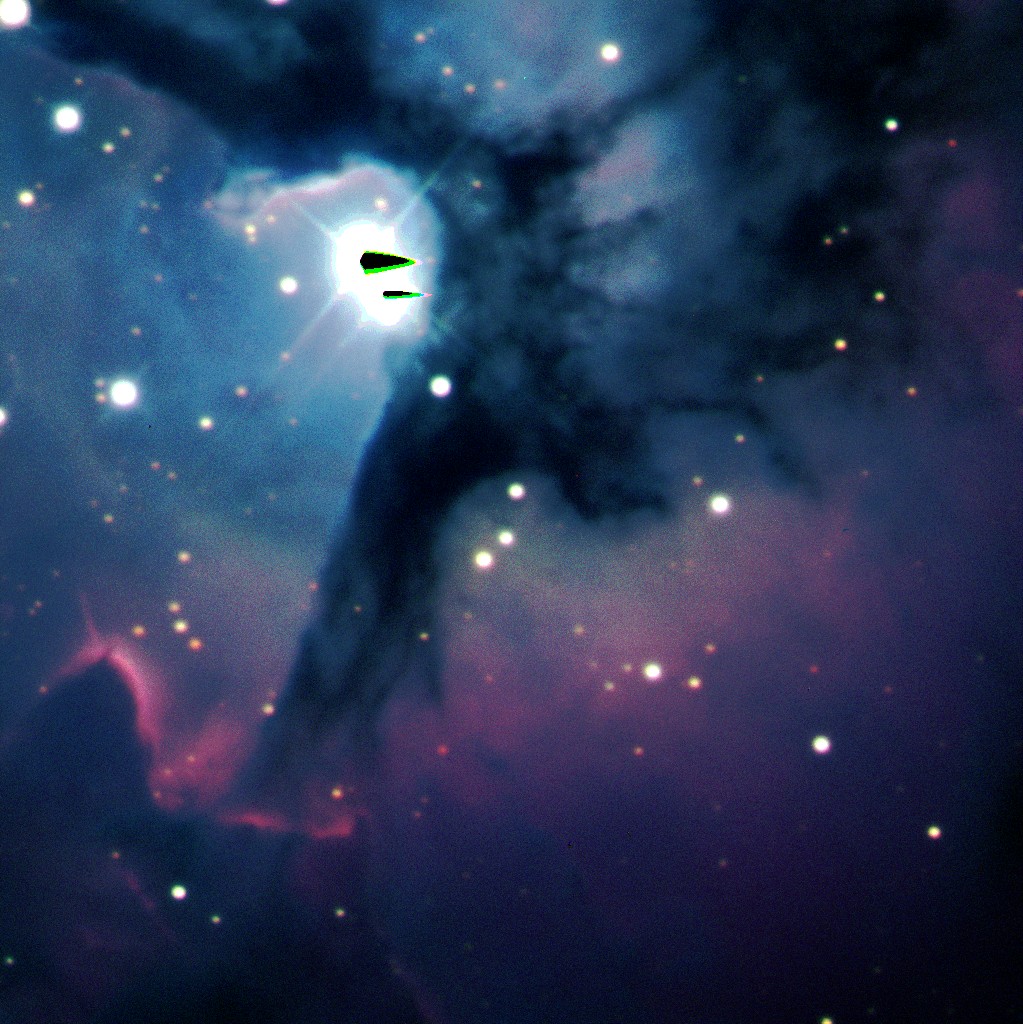
Sky Object Name: triffid Nebula
Taken By: Uplands Community College
When taken: May 13, 2010 13:45:46 UTC
RA: 18h02'42"
DEC: -22°58'19"
Filter: RGB
Exposure time: 60 secs.
Instrument: EM01


Sky Object Name: Eagle Nebula
Taken By: Uplands Community College
When taken: May 13, 2010 13:37:52 UTC
RA: 18h18'52"
DEC: -13°49'00"
Filter: RGB
Exposure time: 60 secs.
Instrument: EM01

Labels: , , , , , , ,

20 Apr 2010

(Please click images to enlarge)

Four Nebulae taken by GCSE Astronomy class

Four very beautiful nebulae taken by Uplands GCSE Astronomy students:

Sky Object Name: Trifid
Taken By: Uplands Community College
When taken: Apr 20, 2010 14:58:27 UTC
RA: 18h02'20"
DEC: -23°03'10"
Filter: H-alpha
Exposure time: 100 secs.
Instrument: EM01

The Trifid Nebula (catalogued as Messier 20 or M20 and as NGC 6514) is an H II region located in Sagittarius. Its name means 'divided into three lobes'. The object is an unusual combination of an open cluster of stars, an emission nebula (the lower, red portion), a reflection nebula (the upper, blue portion) and a dark nebula (the apparent 'gaps' within the emission nebula that cause the trifid appearance; these are also designated Barnard 85). Viewed through a small telescope, the Trifid Nebula is a bright and colorful object, and is thus a perennial favorite of amateur astronomers.


Sky Object Name: Trifid
Taken By: Uplands Community College
When taken: Apr 20, 2010 14:54:41 UTC
RA: 18h02'20"
DEC: -23°03'10"
Filter: RGB
Exposure time: 50 secs.
Instrument: EM01


Sky Object Name: Eagle
Taken By: Uplands Community College
When taken: Apr 20, 2010 14:47:31 UTC
RA: 18h18'52"
DEC: -13°49'42"
Filter: RGB
Exposure time: 50 secs.
Instrument: EM01

The Eagle Nebula (catalogued as Messier 16 or M16, and as NGC 6611) is a young open cluster of stars in the constellation Serpens, discovered by Jean-Philippe de Cheseaux in 1745-46. Its name derives from its shape which is resemblant of an eagle. It is the subject of a famous photograph by the Hubble Space Telescope, which shows pillars of star-forming gas and dust within the nebula.


Sky Object Name: Dumbbell
When taken: Apr 20, 2010 14:40:17 UTC
RA: 19h59'40"
DEC: 22°43'01"
Filter: RGB
Exposure time: 90 secs.
Instrument: EM01

The Dumbbell Nebula (also known as Messier 27, M 27, or NGC 6853) is a planetary nebula (PN) in the constellation Vulpecula, at a distance of about 1,360 light years.

Labels: , , , , , , ,

22 Mar 2010

(Please click images to enlarge)

"Where in Orion is the Afterlife?"

This was one of the questions a curious Yr 6 girl asked former students at Ticehurst Primary School last friday.

Two Yr 11, Ex-Astronomy GCSE students - Robbie Bramall and Connor Lynch - accompanied Mr Pert to the local school to demonstrate Faulkes Telescope. For the last two days Hawaii had been battered by poor weather, but amazingly the skies cleared just in time for the booked slot, where they could remotely control the 2m telescope!

The first image was picked at random from objects, listed once control was taken, available in the sky at the time:


M87

M87

The heart of the galaxy known as M87 is a place of unimaginable violence. A black hole up to seven billion times as massive as the Sun sits at the galaxy's center -- one of the most massive black holes ever measured. As gas spirals into the black hole, it's heated to millions of degrees, so it produces enormous amounts of X-rays. Some of the hot gas around the black hole shoots back into the galaxy in powerful jets that span thousands of light-years.

M87 is at the center of the Virgo Cluster, a collection of thousands of galaxies that move through space together. It is a giant elliptical galaxy, so it's shaped like a fat, fuzzy watermelon. M87's diameter is only a little bigger than the Milky Way's, but because the galaxy is thicker than the thin disk of the Milky Way, it encompasses a much larger volume. As a result, M87 contains many more stars and is perhaps 10 times as massive as the Milky Way.


The next three objects had been researched by Robbie:


Sombrero Galaxy

Sombrero Galaxy

Why does the Sombrero Galaxy look like a hat? Reasons include the Sombrero's unusually large and extended central bulge of stars, and dark prominent dust lanes that appear in a disk that we see nearly edge-on. Billions of old stars cause the diffuse glow of the extended central bulge. Close inspection of the bulge in the above photograph shows many points of light that are actually globular clusters.

The spectacular dust rings harbor many younger and brighter stars, and show intricate details astronomers don't yet fully understand. The very center of the Sombrero is thought to house a large black hole. Fifty million-year-old light from the Sombrero Galaxy can be seen with a small telescope towards the constellation of Virgo.


Whirlpool Galaxy


M64


Aren't they great? :-D The best we've had yet!!


So...Where in Orion is the Afterlife?

....Well, apparently it's in 'Aries'

:-D

Labels: , , , , , , , , , , ,

11 Feb 2010

(Please click images to enlarge)

Yr 11 Physics triple science - No image available

Feb 11th the telescope was not working! (Used by Triple Physics class here at Uplands).
Images of NGC 2613 & NGC 2298 didn't come out... :-(


Labels: , , ,

10 Feb 2010

(Please click images to enlarge)

Viewing a comet

A level class took pictures of a comet for external research reasons. This provided a good start to the A level Cosmology section of the course:


When taken: Feb 10, 2010 10:50:07 UTC
RA: 9h35'19"
DEC: 12°25'10"
Filter: H-alpha
Exposure time: 60 secs.


When taken: Feb 10, 2010 10:46:56 UTC
RA: 9h35'19"
DEC: 12°25'10"
Filter: Blue
Exposure time: 60 secs.


When taken: Feb 10, 2010 10:44:44 UTC
RA: 9h35'19"
DEC: 12°25'10"
Filter: Green
Exposure time: 60 secs.


When taken: Feb 10, 2010 10:42:50 UTC
RA: 9h35'19"
DEC: 12°25'10"
Filter: Green
Exposure time: 60 secs.


When taken: Feb 10, 2010 10:40:01 UTC
RA: 9h35'19"
DEC: 12°25'10"
Filter: RGB
Exposure time: 60 secs.


When taken: Feb 10, 2010 10:33:43 UTC
RA: 9h35'19"
DEC: 12°25'10"
Filter: Green
Exposure time: 60 secs.

Labels: , , , , ,

20 Nov 2009

(Please click images to enlarge)

Faulkes telescope 20th November 2009

These pictures were taken by class 7S1:


Sky Object Name: m76
Taken By: Uplands Community College
When taken: Nov 20, 2009 10:28:27 UTC
RA: 1h42'18"
DEC: 51°34'07"
Filter: Green
Exposure time: 50 secs.
Instrument: EM01


M76 is among the fainter Messier objects. It is known under the names Little Dumbbell Nebula (the most common), Cork Nebula, Butterfly Nebula, and Barbell Nebula, and it was given two NGC numbers as it was suspected to be a double nebula with two components in contact.
Pioneer astrophotographer Isaac Roberts found that this was not a double, but a single nebula, and first suspected it might be a broad ring seen edgewise. In 1918, Heber D. Curtis correctly classified it as a planetary nebula for the first time.


Sky Object Name: m1
Taken By: Uplands Community College
When taken: Nov 20, 2009 10:22:51 UTC
RA: 5h34'31"
DEC: 22°02'02"
Filter: RGB
Exposure time: 90 secs.
Instrument: EM01


The Crab Nebula, Messier 1 (M1, NGC 1952), is the most famous and conspicuous known supernova remnant, the expanding cloud of gas created in the explosion of a star as supernova which was observed in the year 1054 AD. It shines as a nebula of magnitude 8.4 near the southern "horn" of Taurus, the Bull.


Sky Object Name: m33
Taken By: Uplands Community College
When taken: Nov 20, 2009 10:11:49 UTC
RA: 1h33'51"
DEC: 30°39'37"
Filter: RGB
Exposure time: 120 secs.
Instrument: EM01

The Triangulum Galaxy Messier 33 (M33, NGC 598) is another prominent member of the Local Group of galaxies.
M33 is approaching us (our Solar System) at 182 km/s according to R. Brent Tully, or at 179 +/-3 km/s according to NED. Corrected for our motion around the Milky Way's Galactic Center, it is approaching our Galaxy at 24 km/sec.
M33 was among the first "spiral Nebulae" identified as such by William Parsons, the Third Earl of Rosse. It was also among the first "nebulae" identified as galaxies, in which Cepheid variable stars were found;

Labels: , , , , , ,

29 Oct 2009

(Please click images to enlarge)

The trouble with viewing stars in the daytime...


Faulkes Telescope North

Many of us have looked up at the night sky and wondered what's out there. We can see the stars - lots of them - and we see the moon and, if we're lucky and have a little knowledge in which direction to look, we can spot a planet or two.

If we want to look deeper? Learn a little more about our solar system or what's between those twinkling little lights? Well, for years, at Uplands, there has been our GCSE Astronomy class (now held on a Tuesday), and locally there is the Wadhurst Astronomical Society, which meets on the third Wednesday of the month in the Methodist Church, Wadhurst (details on the website).

However, unless there's an event such as a solar eclipse, actual space viewing is difficult in the daytime, because the light from the sun prevents the observation of dimmer objects. Although there are some activities we can, and will, do at school (eg observing and recording sunspots) for studying more distant suns and galaxies we need further assistance...

...and this is where the Faulkes Telescopes come in.

Two large (2m) telescopes have been made available for educational use. In the northern hemisphere, Faulkes Telescope North (FTN) is in Hawaii (Haleakala Observatory ) and in the southern hemisphere, Faulkes Telescope South (FTS) is in Australia (Siding Spring Observatory). The best thing about these two telescopes is they are in nighttime during our daytime, and we can obtain full and exclusive use of them for our half-hour (previously booked) sessions.

As long as there's access to a computer and the internet, the telescopes can be robotically remote controlled from anywhere (I've heard that someone even used an iphone when he couldn't get computer access!) to locate any visible astronomical object of interest (with limits on the brightness), which can then be photographed. The image can then be downloaded for use from the Faulkes Telescope website.

We have now tried out the telescope a few times.

The first trial was a bit of a flop, because there was a glitch in the system and we couldn't get the telescope to take pictures. The second effort was more successful and, using FTN, we managed to take images of the Ring Nebula in Lyra (M57) with colour filters and the hydrogen alpha filter (dark splodges on images are dust on telescope):


FT North:Tue 9 June, 2009 10:30 UTC

M57 (Ring Nebula in Lyra): RGB (Red, Green and Blue) filters


M57 (Ring Nebula in Lyra): H-alpha (hydrogen) filter


as well as a these two interacting galaxies:

NGC 6621: RGB (Red, green, blue) filters


and a cluster of galaxies:

NGC 6027: RGB (Red, green and blue) filters


This year we will be introducing the telescope to all year 7 groups as part of their 'Forces and Space' course, as well as hopefully visiting local primary and secondary schools. More news on this to follow...

Labels: , , , , , , , ,

9 Oct 2009

(Please click images to enlarge)

Open Evening 2009


As usual, all departments put on a good show for Open Evening. The science block emitted flashes and loud foghorn sounds (sound tubes) and provided much interest for visitors.

Astronomy was a special feature this year. The corridor leading to the physics area was adorned with Yr7 students' solar system shoe boxes:


Sam Newton (left), Alice Florey (right)


Edward Davies


Oscar Silburn (left), [un-named] (right)


Georgina Clark (left), Holly Heaton (right)


...and the walls displayed a variety of astronomical pictures, posters and data:


Astronomy board outside Lab 8


Posters by GCSE astronomy group in upstairs corridor
and inside Lab 8, amongst the other displays on the walls:


Lab 8 'Life cycle of stars' board


Detailed picture and diagram labelling the moon's features

Lab 8, Louise Gray

Inside the physics lab there were further astronomical displays...

One of great interest to young students was a program written in C++ from scratch by Dominic Oram, currently yr 13, a former GCSE astronomy student. The program, created as part of an Extended Project scheme, modelled the gravitational interaction between stars and planets. You could change the number of stars/planets (as long as it was less than 200!), each planet’s properties, how much light the stars gave off and see the objects with reflected light. The variables you can change on each planet include spin, mass, size and colour, including the surface texture. The colourful and informative interactive program showed how these changes would affect the orbits of planets around each other. Though already very advanced, the program is still in development, and Dominic is hoping to add further improvements. For example, a simulation of the heat the star creates and so the temperature of each planet orbiting the star.

Dom working on his program

Meanwhile, Sammy Pooley of the drama department had recently created a film from many online clips showing Jupiter and its moons (Io, Callisto, Europa, Ganymede), particularly relevant to the evening because all the department's major telescopes were focused on the planet outside. The film, played throughout the evening, was a beautiful construction of Jupiter and its moons from many angles, set to classical music, with Mikey Pooley (yr 11) providing an informative voice-over, describing what could be seen. Also incorporated into the film was a clip of the current year's GCSE astronomy group, role-playing the four Gallilean moons showing the different orbits around Jupiter.

Outside in the courtyard, long queues formed to see three moons brightly visible in the clear evening sky (the fourth put in a late re-appearance after completing its transit in front of Jupiter). A couple of students manned the telescopes, which needed re-aligning as Jupiter moved across the sky over the course of the evening. Although there was a few teething problems with the new telescope, most people were pleasantly surprised, some highly excited, how easily the moons could be seen, many never having looked at a planet before let alone through a telescope.

Our newest toy (MySky) was also popular (although aiming it proved a challenge for some!) We located the Wild Duck cluster and the comet Whipple.

Unfortunately, due to total forgetfulness, no photos were taken on the night :-(

Labels: , , , , , , , , , , , , , , ,

25 Sept 2009

(Please click images to enlarge)

Faulkes Telescope Thu 17 September, 2009 11:30 UTC

First viewing by class 7p3 : Error extraordinaire...wrong co-ordinates!

Taken from FT's public images, the declination co-ordinates (equivalent to lines of latitude) were off by about a degree or so, and when the size of the image is only 4 arc mins (....so much smaller) we missed our targets completely! :-(

So, I wonder what's in these images:


Unfortunately, we went by a set of co-ordinates on the website that had been wrongly input by a degree or so. Not much when you are close to the object, but in the sky it's a whole different area of sky!

On top of the co-ordinates being wrong for the objects we looked at, the fire alarm went off in the middle of the half hour observation window, so this was one of those 'put it down to experience' moments.

Labels: , ,

23 Sept 2009

(Please click images to enlarge)

Some Uplands archive astronomy photos

GCSE students working outside


Eclipse T-shirt


Eclipse 29.3.06


Using binoculars to project image


Telescope used to project image


Using Solar filter


Saturn taken by a student at Herstmonceaux
with mobile phone through the telescope.


Solar filter


The moon from Herstmonceax


Projected image of the sun showing sunspots


Photograph of circumpolar stars


GCSE coursework, mapping the moon
by Louise Gray

Labels: , , , ,

Related Posts Plugin for WordPress, Blogger...