This was one of the questions a curious Yr 6 girl asked former students at Ticehurst Primary School last friday.
Two Yr 11, Ex-Astronomy GCSE students - Robbie Bramall and Connor Lynch - accompanied Mr Pert to the local school to demonstrate Faulkes Telescope. For the last two days Hawaii had been battered by poor weather, but amazingly the skies cleared just in time for the booked slot, where they could remotely control the 2m telescope!
The first image was picked at random from objects, listed once control was taken, available in the sky at the time:

M87
M87
The heart of the galaxy known as M87 is a place of unimaginable violence. A black hole up to seven billion times as massive as the Sun sits at the galaxy's center -- one of the most massive black holes ever measured. As gas spirals into the black hole, it's heated to millions of degrees, so it produces enormous amounts of X-rays. Some of the hot gas around the black hole shoots back into the galaxy in powerful jets that span thousands of light-years.
M87 is at the center of the Virgo Cluster, a collection of thousands of galaxies that move through space together. It is a giant elliptical galaxy, so it's shaped like a fat, fuzzy watermelon. M87's diameter is only a little bigger than the Milky Way's, but because the galaxy is thicker than the thin disk of the Milky Way, it encompasses a much larger volume. As a result, M87 contains many more stars and is perhaps 10 times as massive as the Milky Way.
The next three objects had been researched by Robbie:

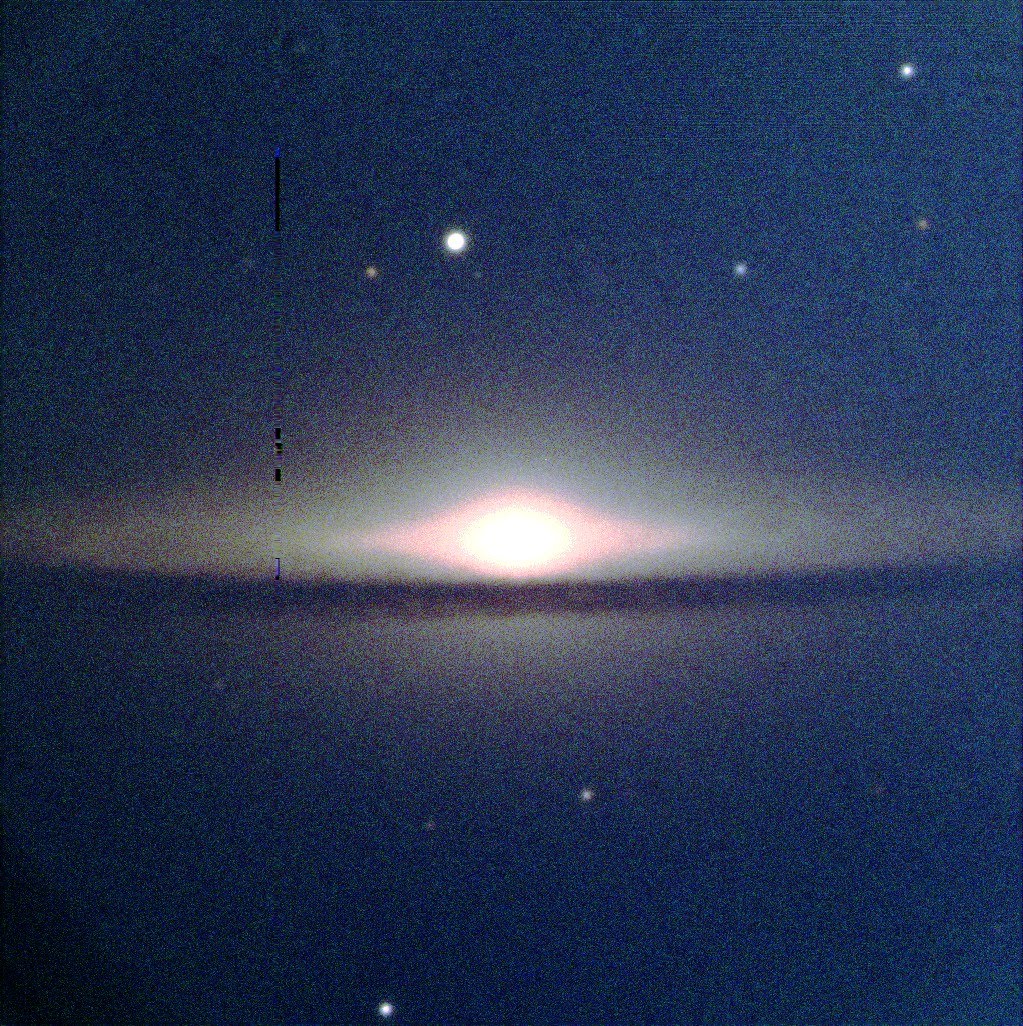
Sombrero Galaxy
Sombrero Galaxy
Why does the Sombrero Galaxy look like a hat? Reasons include the Sombrero's unusually large and extended central bulge of stars, and dark prominent dust lanes that appear in a disk that we see nearly edge-on. Billions of old stars cause the diffuse glow of the extended central bulge. Close inspection of the bulge in the above photograph shows many points of light that are actually globular clusters.
The spectacular dust rings harbor many younger and brighter stars, and show intricate details astronomers don't yet fully understand. The very center of the Sombrero is thought to house a large black hole. Fifty million-year-old light from the Sombrero Galaxy can be seen with a small telescope towards the constellation of Virgo.
 Whirlpool Galaxy

M64
Aren't they great? :-D The best we've had yet!!
So...Where in Orion is the Afterlife?
....Well, apparently it's in 'Aries'
:-D
Labels: astronomy, Faulkes Telescope, M64, M87, observation, observing, Sombrero Galaxy, Ticehurst, Ticehurst Primary School, Uplands Community College, Whirlpool Galaxy, Yr 11




 Ophiuchus
 Mr Meteor


